
What is a PIM – Product Information Management ? Definition, Use Cases & Benefits
You’ve probably landed on a product page and thought: this is really well done. The description is clear. The images show the product from every angle. There’s a size guide, a list of materials, a compatibility chart, and even a short video. Everything just makes sense.
Now imagine managing that level of detail — across 10,000 SKUs, in three languages, on five different sales channels. That’s not a content problem. That’s a product information problem. And that’s exactly what Wassla and other Product Information Management systems are built to solve.
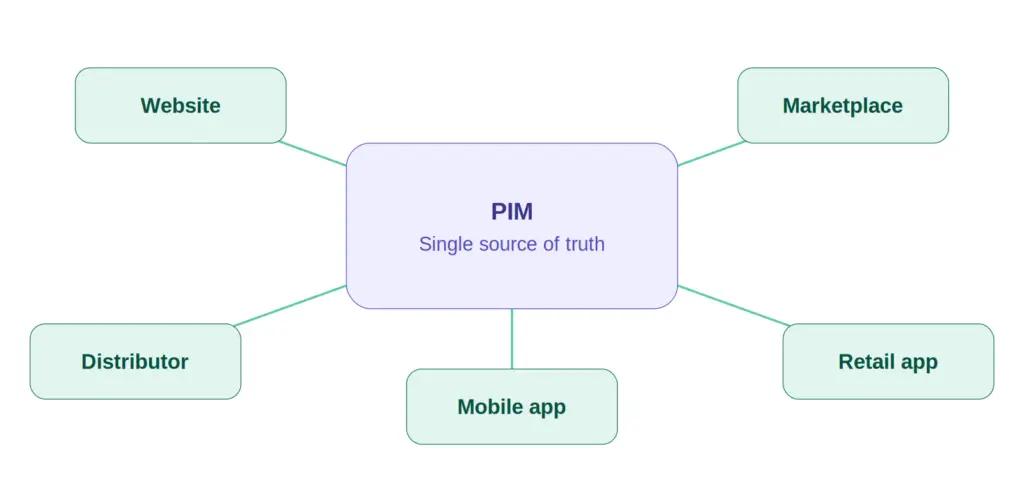
What is a PIM ?
A PIM, or Product Information Management system, is a centralized software platform that enables businesses to collect, organize, enrich, and distribute product data across every sales channel from a single source of truth.
In plain terms: it’s the one place where everything about your products lives — descriptions, dimensions, images, videos, pricing logic, certifications, translations, channel-specific attributes, and more. Instead of that information scattered across spreadsheets, shared drives, ERP exports, and everyone’s inboxes, a Product Information Management system keeps it structured, consistent, and ready to push wherever it needs to go.
A PIM doesn’t replace your e-commerce platform or your ERP. It sits between them and fills a gap both tools were never designed to handle: the messy, content-heavy, always-evolving world of product data.
Why product data is harder than it looks
At Wassla, we have our opinions and conclusions about product information and believe us it’s never just one thing.
A single product might need a short description for a marketplace listing, a longer narrative for your brand website, a technical spec sheet for a distributor, a set of mobile-optimized images for your app, and a localized version of all of the above for a new market you’re entering. The product hasn’t changed — but what you need to say about it has, depending on where and how it’s being sold.
Without a Product Information Management system, managing this means either duplicating work endlessly or accepting that some channels will always have incomplete, outdated, or inconsistent data. Neither is a great option when your customers are making purchase decisions based on what they see.
Who actually uses a PIM ?
Product Information Management is primarily a tool for businesses that sell products — particularly those dealing with catalog complexity, multi-channel distribution, or international expansion. The most common users are:
- E-commerce brands managing large catalogs across platforms like Shopify, Amazon, Zalando, or their own DTC site. For them, a PIM means cleaner listings, fewer returns due to misinformation, and faster time-to-market for new products.
- Manufacturers and distributors who need to share accurate technical data with a network of retailers or partners. A Product Information Management system helps them maintain control over how their products are represented downstream, without chasing down every partner with updated PDFs.
- Retailers sourcing from hundreds of suppliers, each delivering product data in a different format. A PIM becomes the normalization layer — a place to clean, standardize, and enrich before publishing.
- Global brands managing localization at scale. When you’re selling in 12 countries, translating product content isn’t just a language exercise. It often involves adapting units of measurement, compliance language, imagery, and SEO terms for each market. A PIM with localization workflows makes this manageable.
The core use cases of PIM
Let’s get concrete about where a PIM actually earns its place.
1. Centralized product catalog management
Instead of hunting for the “latest version” of a product’s data across multiple systems, everyone — merchandisers, marketers, copywriters, developers — works from the same source. Updates happen once and propagate everywhere. This alone eliminates a significant class of errors that plague high-SKU catalogs.
2. Multi-channel distribution
Whether you’re selling on your own website, Amazon, a regional marketplace, or through a physical retail partner, each channel has its own requirements: different image sizes, character limits, attribute structures. A solid PIM like ours lets you map and publish product data to each channel in the right format without rebuilding everything from scratch every time.
3. Product content enrichment
Raw data coming out of an ERP or supplier sheet is rarely ready to sell. It needs descriptions, lifestyle imagery, keywords, and storytelling. A Product Information Management system gives content teams a structured environment to enrich product data at scale — with workflows, approval steps, and completeness scores that tell you when a product is truly ready to go live.
4. Translation and localization
Most PIMs come with localization features built in, allowing you to manage language variants in parallel. Rather than emailing translated files back and forth, teams work in-platform with version control and clear visibility into what’s been approved for each market.
5. Faster time-to-market
One of the clearest ROI arguments for PIM is speed. When product data is structured, enriched, and ready to publish, launching a new product — or entering a new channel — goes from weeks to days. For fast-moving consumer categories, that matters.
6. Reduced return rates
Returns are often the result of poor or misleading product information. Customers receive something different from what they expected because the description was vague, the dimensions were wrong, or the images didn’t show the full picture. Better product data, managed through a PIM, means fewer mismatched expectations — and fewer returns hitting your margins.
What to look for in a PIM system
Not all PIMs are built the same. Depending on your business, you’ll want to evaluate a few key things:
Connector ecosystem — Does it integrate natively with your e-commerce platform, ERP, and the marketplaces you sell on? The fewer manual exports, the better.
Data modeling flexibility — Can you define custom attributes and structures that match your product catalog’s logic? A tool built for fashion shouldn’t force a food brand into its category structure.
Workflow and collaboration features — Who approves content before it goes live? Can translators, brand managers, and category managers work in parallel without stepping on each other?
Channel-specific outputs — Can you define different views or exports for different destinations, rather than publishing one version everywhere?
Scalability — If you double your catalog size next year, or expand into three new markets, will the system hold up?
The bottom line
A Product Information Management system isn’t a flashy technology. It doesn’t show up on your customer-facing product pages with a logo. But it’s often the infrastructure that separates brands with consistent, conversion-ready product content from those constantly fighting fires — wrong images live, outdated specs in the wild, markets launched late because no one could find the right data.
If you’re managing product data across multiple channels, languages, or teams, a PIM isn’t a nice-to-have. It’s the operational backbone that makes everything else — your e-commerce, your marketing, your expansion plans — actually work at scale. Choose Wassla and change the game.
On this page
Move money on Wassla
See live corridors, ceilings and settlement times for your markets.